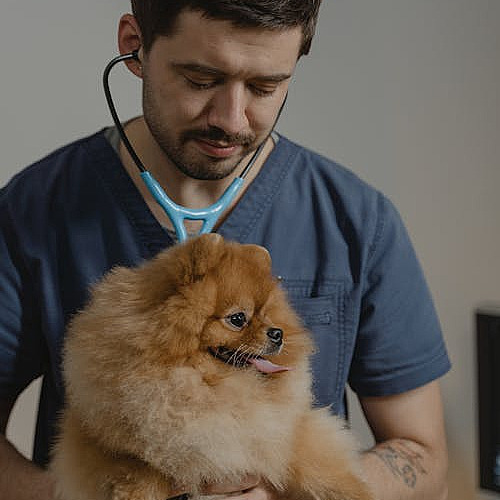
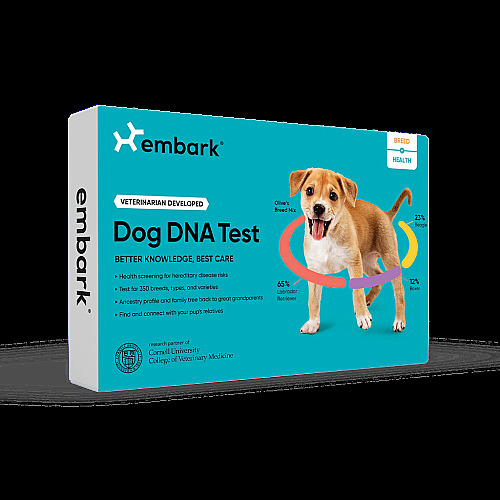
If you’ve been wondering if getting your dog tested is worth the financial investment, you may be surprised by how much you get for your dollar. The Embark Breed + Health Test screens for 270+ health conditions, 400+ breeds, and 55 traits using research-grade genotyping developed in partnership with Cornell University College of Veterinary Medicine.
What Your Vet Could Know Before Your Next Appointment
Embark Breed + Health | Basic Breed-Only Test | |
|---|---|---|
MDR1 drug sensitivity | ✅ Screened — lets your vet adjust prescriptions before a reaction occurs | ❌ Not included |
Allergy Risk Scores (all 4 types) | ✅ Proprietary — no other dog DNA test offers this | ❌ Not included |
Spinal / IVDD risk (chondrodystrophy) | ✅ Screened — informs activity and weight management early | ❌ Not included |
Von Willebrand bleeding disorder | ✅ Screened — critical to know before any surgery | ❌ Not included |
MCT cancer risk score | ✅ First-of-its-kind — now applies to all dogs, not just high-risk breeds | ❌ Not included |
Total health conditions screened | ✅ 270+ | ❌ Minimal or none |
Research partnership | ✅ Cornell University · >99% breed accuracy · 50,000+ five-star reviews | ⚠️ Varies by brand |
Our pick: The Embark Breed + Health Test is the most complete picture you can get of your dog's genetics — breed, health risks, traits, and the only allergy risk assessment on the market.
Shop our pick below 👇
A few things worth knowing before you scroll:
270+ health conditions across 400+ breeds screened
Proprietary Allergy Risk Scores across four allergy types
Proprietary MCT risk score, the first cancer-related genetic risk assessment from a dog DNA company
Relative Finder connects your dog with genetic relatives in Embark’s database
>99% accuracy for breed ancestry identification
Cornell University research partnership
50,000+ five-star reviews
1. Medication Sensitivity: What Your Vet Needs to Know Before Prescribing

Here's a scenario no one wants: Your dog goes in for routine surgery, and they have a serious reaction to a standard sedative. That's why one of the most practically useful things a dog DNA health test can reveal is whether your dog carries the genetic variant associated with MDR1 drug sensitivity. As Cornell University's Riney Canine Health Center explains, knowing a dog's MDR1 status before treatment allows veterinarians to adjust drug choices and dosages, potentially avoiding a dangerous reaction altogether. Dogs who carry this variant may have serious reactions to certain medications, including some sedatives, antiparasitic drugs, and chemotherapy agents, at doses that other dogs tolerate without issue.
MDR1 is found in the ABCB1 gene and affects a protein called P-glycoprotein that normally keeps drugs from accumulating in the brain. The MDR1 variant is most common in herding breeds like Australian Shepherds, Collies, and Border Collies, but it appears in many other breeds and mixes.
If your dog ever needs surgery, anesthesia, or treatment for parasites or cancer, that conversation is easier when your vet already has the data. Embark includes MDR1 screening as part of its full health panel, so you can walk in prepared.
2. Allergy Risk Scores: Getting Ahead of the Itch

Skin allergies are one of the most common and costly conditions a dog owner will face, and it’s one that tends to worsen over time if not managed early. Most pet parents assume they'll notice when their dog develops them, but by the time the signs are hard to miss, your dog has likely already been uncomfortable for months.
Skin allergies have been the number-one claim in dogs with Nationwide pet insurance for 15 consecutive years. In 2024, they accounted for 16% of all dog-related claims, with annual management costs reaching $1,000–$2,000 for many dogs.
Embark’s proprietary Allergy Risk Scores analyze genetic predisposition across four allergy types: environmental, food, flea, and contact. No other dog DNA company offers this feature. Nearly 12% of Embark buyers specifically purchased for allergy risk insights, a figure that reflects just how much this concern weighs on pet parents, often before symptoms are obvious enough to act on.
These scores do not diagnose allergies or identify specific allergens. They can, however, support early conversations with your vet about monitoring, management strategies, and lifestyle adjustments, which makes a real difference when allergies tend to emerge in the first one to three years of a dog’s life.
3. Spinal Health: Understanding Your Dog’s Disc Disease Risk

If you have a Dachshund, French Bulldog, or Corgi, you’ve probably heard the warning: watch their back. What most owners don’t hear is that a specific genetic variant is driving that risk and that it can show up in breeds and mixes you wouldn’t expect. Knowing about it early changes the vet conversation entirely.
Intervertebral disc disease, or IVDD, is one of the most common neurological conditions in dogs, and severe cases can result in significant spinal injury. A genetic variant associated with chondrodystrophy, the skeletal condition that gives breeds like Dachshunds and French Bulldogs their characteristic short-legged build, also significantly raises the risk of Type I IVDD. Research published in the Proceedings of the National Academy of Sciences identified this FGF4 retrogene variant and found that dogs with one or two copies of it face a substantially elevated risk for disc herniation.
Embark screens for this chondrodystrophy-linked variant and reports it as part of the Breed + Health Test results. Because this variant is dominant (meaning even a single copy raises risk), knowing about it early gives you and your vet the chance to discuss weight management, activity modifications, and monitoring protocols before the spine is ever under stress. Embark’s own guidance suggests that dogs with this result can benefit from low-impact exercise, a lean body weight, and avoidance of high-impact activities that compress the spine.
4. Bleeding Disorders: What to Know Before a Routine Procedure

Von Willebrand disease is the most commonly inherited bleeding disorder in dogs, and it often goes undetected until it matters most. The condition, caused by a deficiency in a key blood-clotting protein, means affected dogs may bleed excessively after trauma or surgery. For some, the first sign shows up during a routine spay or neuter. According to Cornell University’s Riney Canine Health Center, early identification allows vets to plan accordingly.
The condition affects over 30 breeds. Doberman Pinschers carry the highest incidence, with studies showing more than 70% of the breed are carriers, but Pembroke Welsh Corgis, Poodles, and Shetland Sheepdogs are also commonly affected. Mixed-breed dogs may carry it as well. Many affected dogs never show signs until a stressful event, like surgery, brings bleeding that is difficult to control.
Knowing your dog’s status before any planned procedure gives your vet the opportunity to prepare: ordering pre-surgical blood products, adjusting the anesthetic plan, or simply monitoring more closely. The Breed + Health Test screens for von Willebrand disease variants, so you can go into a spay or neuter appointment with that information already in hand.
5. MCT Risk: A First-of-Its-Kind Genetic Risk Score

Most dog owners think of cancer screening as reactive: something a vet brings up after finding a lump or noticing something on an exam. Genetic risk scoring for cancer is a newer concept, and it’s reasonable to wonder what you’d actually do with that information before anything appears.
Mast cell tumors are among the most frequently diagnosed skin cancers in dogs, representing roughly 16–21% of all canine skin tumors. When caught early, they’re often treatable, but they can look like an insect bite, a wart, or a benign lump, which makes early detection difficult without a reason to look closely.
Embark's MCT risk score is the first cancer-related genetic risk assessment offered by a dog DNA company, and it just got significantly more useful. The updated model now applies to all dogs, not just those with ancestry in certain higher-risk breeds, and results now identify whether your dog has a below-average, average, or elevated risk. That distinction matters. Rather than simply flagging a concern, the score gives you and your vet a meaningful starting point for a conversation about monitoring frequency and what to watch for on routine exams.
This is not a cancer diagnosis. It does not predict whether a dog will develop mast cell tumors. What it can do is support more informed, proactive monitoring conversations, and for dogs in higher-risk breeds, that kind of informed attention may matter. Discuss your dog’s MCT risk score with your vet to understand what it means for their specific situation.
A Test Worth Having Before You Need It
The best time to get your dog’s DNA tested isn’t when something goes wrong. It’s while they’re young, healthy, and have a long life ahead of them.
Each of the five insights above represents something a vet can actually act on: a drug dosing adjustment, a management plan, a surgical prep protocol, or a monitoring schedule. None of them requires a diagnosis first.
The Embark Breed + Health Test covers all of them with a single cheek swab and a prepaid return mailer. Results are typically ready within 2–4 weeks of the lab receiving the sample, and they stay with you for the life of your dog, updating as Embark’s science continues to evolve. If you order and change your mind, unused kits can be returned for a full refund within 60 days.
The test is currently priced at $110, though Embark runs promotions regularly, so check the product page for the latest price before purchasing. Other dog DNA tests exist at lower price points, but most focus on breed identification alone. The Embark Breed + Health Test goes considerably further, covering 270+ health conditions with a Cornell University research partnership behind the science and proprietary features like Allergy Risk Scores that no other consumer dog DNA test offers.
This article is sponsored by Embark Veterinary. Genetic screening results are not a substitute for professional veterinary advice. Embark’s health reports are intended to inform conversations with your veterinarian, not to diagnose, treat, or prevent any health condition. The MCT risk model is ancestry-based and may not apply to all dogs. Consult your veterinarian before making any changes to your dog’s care plan based on genetic results. Pricing is subject to promotional variation; verify current pricing at embarkvet.com before purchase.







Leave a Comment
Your email address will not be published. Required fields are marked *