
Any dog can develop allergies, regardless of breed, age, or background. Roughly 20% of dogs are affected, and most pet parents only learn about their dog’s susceptibility after the scratching, hot spots, or ear infections have already started. By that point, you’re managing symptoms rather than getting ahead of them. Genetic science is changing that equation. New DNA-based tools can now assess your dog’s individual risk for allergies before symptoms ever appear, giving you and your vet a head start that simply wasn’t available until recently.
Before the Scratching Starts
With Embark Allergy Risk Scores | Without Genetic Testing | |
|---|---|---|
When you learn about risk | ✅ Before symptoms develop | ❌ After itching, ear infections, or hot spots begin |
Starting point for your vet | ✅ Specific genetic scores for all 4 allergy types | ⚠️ Breed generalizations and symptom observation |
Time to actionable insight | ✅ 2–4 weeks | ❌ Months of elimination diets and trial and error |
First-year allergy costs | ✅ One-time test | ❌ Up to $841 in reactive treatment — and climbing |
Pet insurance timing | ✅ Secure coverage before pre-existing conditions develop | ❌ Allergies may be excluded once symptoms begin |
Mixed-breed accuracy | ✅ Scored against your dog's individual ancestry | ⚠️ Breed averages don't account for individual genetic variation |
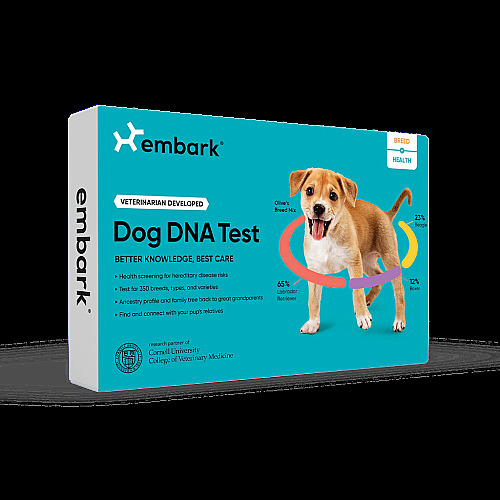
Our pick: The Embark Breed + Health Test is the most complete picture you can get of your dog's genetics — breed, health risks, traits, and the only allergy risk assessment on the market.
Shop our pick below 👇
Dog Allergies Cost Owners $841 a Year on Average

Dog allergies aren’t just a mild inconvenience for you and a temporary annoyance for your dog. Skin allergies have been the number one pet insurance claim for dogs for 13 consecutive years, according to Nationwide’s 2025 analysis of over one million insured pets. First-year treatment costs for skin allergies can reach approximately $841, according to estimates, and because allergies tend to be chronic conditions, those costs compound over a dog’s lifetime.
Dogs can develop four distinct types of allergies, each with different triggers and treatment paths. Understanding these categories matters because managing a flea allergy looks nothing like managing a food allergy.
Environmental allergies (atopy) are triggered by pollen, dust mites, and mold. They’re the most commonly diagnosed type and can cause year-round or seasonal itching, ear infections, and skin irritation.
Contact allergies are less common and develop when a dog’s skin reacts to direct contact with certain materials, chemicals, or plants. They can be especially difficult to diagnose because symptoms overlap with other allergy types.
The challenge with all four types is that symptoms look remarkably similar. Itching, redness, and ear infections can point to any of them, which is why so many dog parents end up in a lengthy process of trial and error before identifying the culprit. “We developed our Allergy Risk Scores to help pet parents prioritize where to investigate first,” says Hilary Tanenbaum, PhD, Director of Applied Science at Embark.
Nearly Half of Your Dog’s Allergy Risk Is Genetic
Research on canine atopic dermatitis has established that allergies are highly hereditary. A well-known study of Labrador and Golden Retrievers in the UK found that nearly 50% of a dog’s risk for developing atopic dermatitis was determined by their genotype. Certain breeds show elevated rates of allergic skin conditions, including Golden Retrievers, Labrador Retrievers, Boxers, French Bulldogs, and West Highland White Terriers, according to the 2024 International Committee on Allergic Diseases of Animals (ICADA) review published in Veterinary Dermatology.
But breed generalizations only capture part of the picture. Two Labrador Retrievers from different lines can have dramatically different allergy risk profiles because of variations in their individual genetic makeup. Breed averages are useful for understanding population-level trends, but they’re an unreliable barometer when it comes to predicting what will happen with your specific dog.
What Embark Allergy Risk Scores Deliver at a Glance
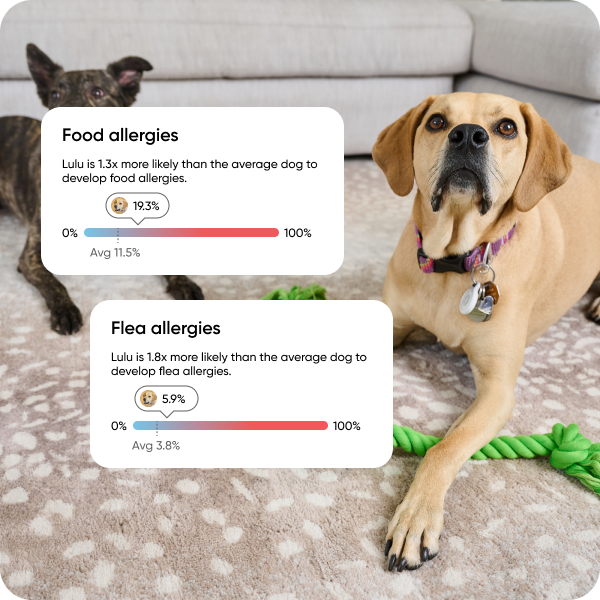
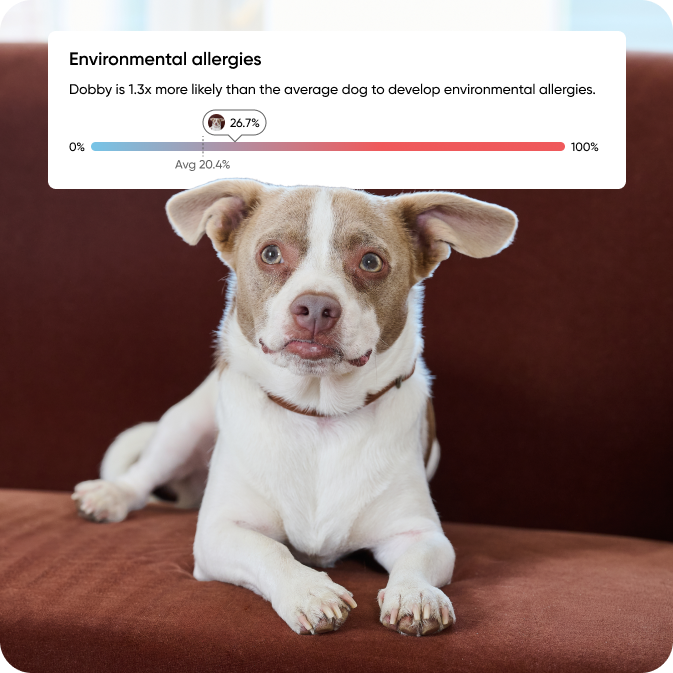
Four individual risk scores (environmental, food, contact, flea) rated 0–100%
Scores built from genetic data from over 2 million dogs
Genetic variants in the models explain 50–80% of a dog’s allergy risk
Correctly identifies 78–95% of dogs as either having or not having allergies, depending on the allergy type
Developed in partnership with Cornell University College of Veterinary Medicine
Results include both absolute risk and relative risk compared to the average dog
Scores are tailored to each dog’s specific ancestry, whether purebred or mixed breed
Included with every Embark Breed + Health Test or via upgrade on Embark’s Breed ID Test
How DNA-Based Allergy Risk Scores Actually Work

The Embark Breed + Health Test is the first dog DNA test to offer genetic risk scoring for all four allergy types. The process starts with a simple cheek swab, the same one that identifies your dog’s breed mix and screens for 270+ genetic health conditions.
Behind the scenes, Embark’s scientists built proprietary statistical models using genetic data and owner-reported allergy diagnoses from hundreds of thousands of dogs. These models analyze each dog’s genotype at the most significant genetic markers, factoring in chromosomal sex and genetic diversity to calculate a personalized score for each allergy type.
The result is four separate scores, each on a 0–100% scale, showing your dog’s likelihood of developing environmental, food, contact, and flea allergies. A dog with a 20% food Allergy Risk Score, for example, has roughly a one-in-five chance of developing food allergies over their lifetime. The scores also show how your dog’s risk compares to the average, which adds practical context that breed-level statistics can’t provide.
Same Breed, Different Risk
Most allergy guidance available to dog parents boils down to breed associations. If you have a French Bulldog, you may read that the breed tends toward skin sensitivities. If you adopted a mixed-breed pup from a shelter, the guidance gets even less specific.
The Embark approach is fundamentally different because it analyzes hundreds of individual genetic variants alongside your dog’s breed ancestry rather than relying on population averages. According to Takeshi Kawakami, PhD, Principal Scientist at Embark, “Over a three-year research effort, we integrated genomic data from 2 million dogs with more than 500,000 health surveys—analyzing over 200,000 variants—to develop our Allergy Risk Scores. These models correctly identify 78–95% of dogs as either having or not having allergies, depending on the allergy type. When our test predicts more than 50% risk of allergies, 71–81% of those dogs actually show allergy symptoms.”
The models also account for the fact that certain genetic variants have different effects across different breeds, so the system identifies which models best correspond to your dog’s individual ancestry. This is especially valuable for mixed-breed dogs, who make up the majority of the pet population and don’t fit neatly into breed-specific risk categories.
Allergy Scores You Can Actually Act On

Knowing your dog’s allergy risk profile is not about planting a seed for future anxiety. It’s about having specific, actionable information before problems develop. Here’s how that translates into real-world decisions.
If your dog scores high for environmental allergies, you can discuss proactive strategies with your veterinarian, such as regular wiping after outdoor activities, air filtration, or early introduction of supportive supplements. A high flea allergy score makes a strong case for year-round flea prevention rather than seasonal-only treatment. Elevated food allergy risk might prompt you to introduce dietary monitoring earlier, potentially avoiding the lengthy and stressful elimination diet process down the road.
Perhaps the most underappreciated benefit is financial planning. Pet insurance policies generally exclude pre-existing conditions, so understanding your dog’s allergy risk before symptoms develop allows you to secure appropriate coverage while your dog is still healthy. Given that chronic allergy management can cost hundreds to thousands of dollars annually, this kind of foresight carries real financial weight.
You can also share your dog’s results directly with your veterinarian from the Embark app, turning what might otherwise be a vague conversation about breed tendencies into what Tanenbaum describes as “an earlier, genetics-informed starting point for conversations with [your] veterinarian.”
One Test Covers More Than Just Allergies
The Allergy Risk Scores come as part of the Embark Breed + Health Test, which also screens for 400+ breeds, types, and varieties, 270+ genetic health conditions, and 55 physical traits. Results typically arrive in 2–4 weeks.
The test also includes the Relative Finder feature, which connects your dog with genetic relatives in Embark’s database. While this is more of a fun bonus than a health tool (after all, who doesn’t want to deep-dive into their pet’s gene pool?), it reflects the depth of Embark’s data set, which is the largest of its kind and powers the accuracy behind all of the test’s insights.
Predict Allergies Instead of Chasing Symptoms

Dog allergies are common, chronic, and expensive to manage once they’re full blown. Most pet parents discover their dog’s allergic tendencies only after a cycle of vet visits, misdiagnoses, and reactive treatments. The emerging science of canine genetic risk assessment offers a meaningful alternative by identifying susceptibility at the DNA level, before symptoms start driving the conversation.
The Embark Breed + Health Test is backed by Embark’s partnership with Cornell University College of Veterinary Medicine and supported by thousands of five-star reviews from pet parents. Free standard shipping is currently included with US orders.
Give your dog the advantage of knowing what their DNA reveals about allergy risk, breed ancestry, and genetic health.
Allergy Risk Scores indicate genetic predisposition and do not diagnose allergies. Individual results may vary based on environmental factors and allergen exposure. Always consult your veterinarian for diagnosis and treatment.







Leave a Comment
Your email address will not be published. Required fields are marked *