Cats have spent thousands of years living alongside humans, yet they still manage to leave their owners completely baffled on a daily basis. From late night zoomies to aggressive kneading sessions on your stomach, feline behavior often seems random, bizarre, or even a little unhinged. Most of these quirks, though, have deep evolutionary roots and serve real biological purposes. Understanding what drives them can strengthen the bond between you and your cat and help you recognize when something might actually warrant a vet visit.
1. The Late Night Zoomies Have an Evolutionary Explanation
You’re half-asleep at 4 a.m. when your cat suddenly launches off the bed, tears through the hallway, and ricochets off the couch like a furry pinball. This burst of frantic energy, sometimes called “frenetic random activity periods” (FRAPs), is rooted in your cat’s biology as a crepuscular predator. Cats are naturally most active at dawn and dusk, which means their internal clock peaks while yours is on autopilot. Indoor cats that spend much of the day sleeping accumulate pent-up energy that eventually needs an outlet. Providing interactive play sessions in the evening, such as 15 minutes with a feather wand or laser pointer, can help redirect those zoomies to a more reasonable hour.
2. Kneading Is a Comforting Leftover From Kittenhood
When your cat rhythmically pushes their paws against a blanket, your leg, or your full bladder, they’re performing a behavior that began in the first days of life. Kittens knead their mother’s mammary glands to stimulate milk flow during nursing. Adult cats retain this motion as a self-soothing mechanism, often accompanied by purring and a slightly glazed expression.
If that’s not endearing enough, some behaviorists also suggest that kneading activates scent glands in the paw pads, which means your cat may be marking you as “theirs.” This usually looks (and feels!) super adorable but can quickly turn to carnage when the claws come out of their murder mittens. If this happens, keeping nails trimmed or placing a thick blanket on your lap can save your skin without interrupting the bonding moment.
3. Your Cat Brings You “Gifts” Because You’re a Terrible Hunter
Most cat lovers have probably seen an Instagram or Facebook video where you hear a cat’s inner monologue. This usually consists of them expressing their befuddlement on how humans survive when we have very few hunting skills. While these are usually pretty funny, there may also be a lot of truth to them! Finding a dead mouse on your pillow or a half-eaten lizard by the front door is unsettling, but your cat likely considers it a generous act.
Research on feline hunting suggests that cats sometimes bring prey to members of their social group. One prevailing theory holds that your cat perceives you as an incompetent fellow cat who clearly can’t catch your own food. Spayed and neutered cats are just as likely to exhibit this behavior, which indicates that it’s driven by social instinct rather than reproductive hormones. If outdoor hunting is a concern for local wildlife (and for your nice white bedding and mental sanity), a brightly colored collar cover can reduce bird captures by 42%, according to a University of Exeter study. The same research found that switching to a high-protein, meat-based diet reduced overall prey brought home by 36%, and daily play sessions cut it by 25%.
4. Sitting in Boxes Satisfies a Deep Need for Security
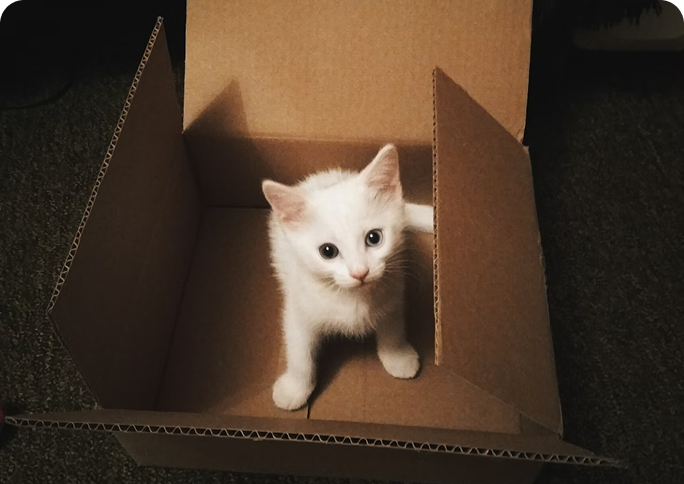
If I fits, I sits! A cat will ignore a $60 cat bed to cram itself into a shoebox roughly half its size and make itself into the equivalent of a feline muffin top. And we aren’t just talking about house cats, either. Large cats such as tigers and lions have also exhibited this behavior. This preference for tight, enclosed spaces is a stress-reduction strategy. A well-cited study from Utrecht University found that shelter cats given hiding boxes showed significantly lower stress levels and adapted to new environments faster than cats without them. Enclosed spaces provide insulation, reduce the number of directions a threat can approach from, and create a cozy microclimate. If your cat loves boxes, it’s a sign that they’re seeking comfort, not being strange.
5. Slow Blinking Is Your Cat Saying “I’m Comfortable”
When your cat looks at you and slowly closes and opens their eyes, they’re delivering the feline equivalent of a warm smile. A 2020 study in Scientific Reports confirmed that cats respond positively to human slow blinks and are more likely to approach a person who slow blinks at them than one who maintains a neutral expression. This makes perfect sense if you think about it from an evolutionary standpoint. In the animal world, prolonged direct eye contact is often a threat signal, so deliberately breaking that gaze communicates safety and affection. Try slow blinking back at your cat the next time you catch their eye. You may find they return the gesture.
When Quirky Cat Behavior Becomes a Health Concern
Most odd cat behaviors are usually perfectly normal, but sudden changes in habits can signal health problems. A cat that starts hiding constantly, stops grooming, eats non-food items (a condition called pica), or develops new aggression should see a veterinarian. Behavioral shifts are one of the earliest indicators of illness, and cats are notoriously good at masking pain. Keeping a mental log of your cat’s typical quirks makes it much easier to spot when something feels off.
Your cat’s weirdest habits are usually their most natural ones. The zoomies, the kneading, the box obsession: These are all signs of a healthy, instinct-driven animal doing exactly what millions of years of evolution designed it to do. The fact that it also happens to be hilarious is just a bonus.






Leave a Comment
Your email address will not be published. Required fields are marked *