There’s a particular quiet in the first hours after an adoption goes through. Your new dog is still deciding whether to trust the situation while you rearrange your life around them. That choice, made in a single afternoon, ranks among the kindest anyone can make.
Somewhere in the paperwork that traveled with you, a line reads breed. Under it sits a guess: Lab mix, terrier cross, something near enough to work with. Whatever appears there was offered in good faith by people who adore animals and see hundreds of them a year.
But that label is only surface-level, omitting critical details such as which health risks your pup was born with, what their body is built to handle, or who else shares their DNA. All of that already lives inside them. None of it is visible to the naked eye.
Why Breed Labels Are a Best Guess
Shelters assign breed labels because no alternative exists. Adopters ask, kennel cards need filling in, and eyeballing a new arrival is the only option available when a stray comes in with no paperwork and no history.
Researchers at Arizona State University measured how well the method holds up. Their 2018 study, still the largest of its kind, genotyped 919 shelter dogs at two organizations and compared the science against what employees had recorded.
At the San Diego site, where 384 dogs were evaluated, staff correctly named at least one breed in the mix 67.7% of the time. Asked for a primary and a secondary breed together, they matched on 10.4%. For roughly a third of those pups, the written label appeared nowhere in the genetic report, even three generations back.
What Genetics Hide in Plain Sight
That’s no knock on the folks doing this work. Fewer than 5% of the animals sampled were purebred, and no human eye can reliably separate that many bloodlines at a glance. Assessment by sight hits a ceiling that has nothing to do with care or competence.
The reason sits in the genome. A small number of gene regions control the features people read when they guess: ear carriage, coat length and curl, muzzle shape, and overall size.
They travel independently of the rest of a dog’s ancestry, which means a pup can inherit the silhouette of one breed while carrying almost none of it. The resemblance is genuine, but it isn’t a family tree.
What a DNA Test Adds to an Adoption Story
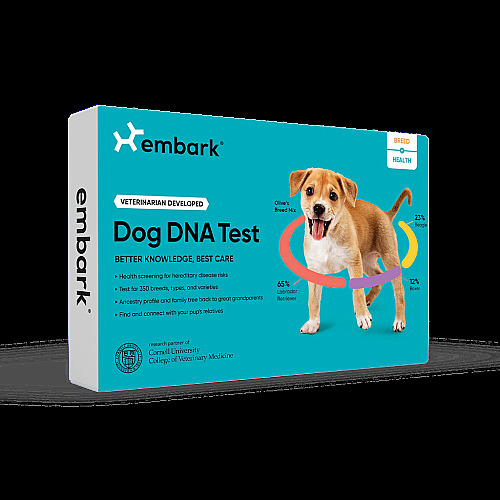
Genetic testing fills in the chapters nobody was around to write down. Here’s the short version of what the Embark Breed + Health Test reads from a single sample:
Breed makeup across 400+ breeds, types, and varieties, at 99% ancestry accuracy
Screening for 270+ genetic health risks, drawn from over 100,000 genetic markers
Allergy risk scores covering environmental, food, contact, and flea
55 physical traits, including predicted adult weight, coat texture, and shedding
Relative Finder, which matches your dog’s genetics against the database and lets you message the households who have their relatives
Everything above comes from one cheek swab. Results generally arrive within 2–4 weeks of the lab receiving what you mailed.
The Health Details a Label Can’t Tell You
Knowing your dog’s breed mix pays off when it tells you what to watch for. Inherited risks rarely announce themselves at a routine checkup, and a kennel card isn’t built to capture them.
The Embark Breed + Health Test screens for more than 270 genetic health risks from one swab. Three in four dogs tested show a health finding.
That figure sounds frightening until you sit with it. For the recessive variants that make up most of the panel, carrying a single copy usually means no symptoms ever surface. What the report buys you is a head start on proactive care, plus something your vet can keep in mind.
The kit also grades allergy risk for environmental, food, contact, and flea triggers. Those scores aren’t diagnoses, but they flag which allergy types to raise at your next appointment.
Embark goes further with a mast cell tumor risk estimate, the first cancer-related risk assessment from any dog DNA company. MCT is among the most common skin tumors in dogs, and more than 80% of cases are curable by surgery alone when caught early. Having that insight before a lump ever appears can change the outcome.
What a rescue parent walks away with is concrete:
A written health record for a pup who arrived without one
Predispositions worth watching before any signs appear
Finding the Family They Left Behind
Adoption almost always leaves a chapter missing. Somewhere out there sits a litter, a mother, perhaps siblings placed with families a few towns over.
Embark’s Relative Finder scans every profile in the database for shared DNA. Roughly 94% of pups tested turn up at least one relation as close as human first cousins, and you can reach out to those families directly.
For adopters, that lands differently than it does for anyone else. Littermates separated at intake do find each other again, often enough that Embark keeps publishing the reunions.
The Next Step After Bringing Them Home
You answered the biggest question your dog had. Testing answers the ones handed to you along with the leash: what they’re made of, what to prepare for, and who they descend from.
The Embark Breed + Health Test is $199 with free shipping in the continental US.
Beyond breed and health, the kit also surfaces 15 behavior insights: the genetic backstory behind common challenges like barking at the door, lunging on leash, and separation anxiety. Embark is the only dog DNA test that then uses those insights to create a personalized training plan just for your dog to address those behaviors.
One more item worth noting. Since 2015, Embark has supported shelters and rescues with free DNA tests, fundraisers, and adoption events. They partner with Shelter & Rescue organizations throughout the US and Canada, and pet parents who adopted from a participating organization qualify for a discount.
The paperwork you got gave you an honest guess. Filling in the rest is the next gift you get to give them.
Prices and product details were verified at the time of publication and are subject to change without notice.
This content is informational and is not a substitute for professional advice. Consult your veterinarian regarding your dog’s health.



Leave a Comment
Your email address will not be published. Required fields are marked *